
Russian Native Ad: No Common Ground on ISIS

Är innehållet ändamålsenligt eller skadligt?

ÄNDAMÅLSENLIGT SKADLIGT

Translate to other languages

English Dutch French German Italian Portuguese Russian Spanish

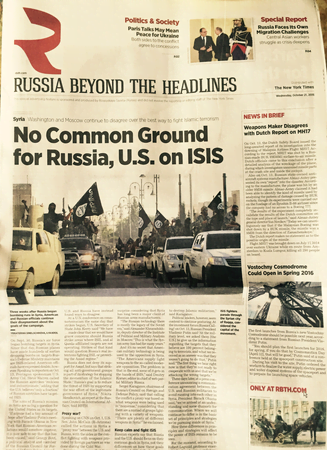
Russian Native Ad: No Common Ground on ISIS

Bakgrundsinformation
New York Times October 21, 2015 section says, "Distributed by the New York Times" and offers an array of good news about business and tourism.
Vilken metod används
Simplify Ideas
Detta är mediepåverkan för att
It looks like news but it's really public relations, paid for my Rissiyskaya Gazeta, funded through advertising and sponsorship from Russian government agencies. They publish these "supplements" in 36 countries and reach 25 million people.

Comments

  1. user-avatar
    Berrystella
    ons, 11/18/2015 - 22:46
    Berrystella
    I agree it is simplifying an idea, and it also is harmful because it looks like news. It should be very clear that it is a sponsored advertisement
  1. user-avatar
    Trevor Bloom
    fre, 11/20/2015 - 00:00
    Trevor Bloom
    I think this picture does a decent job of trying to communicate it's idea. My rating was in the middle, with 36% of other people responding the same way I did.
  1. user-avatar
    Casandra
    sön, 11/22/2015 - 03:49
    Casandra
    At first glance this caught my attention because I did think it was a newspaper. Until I read the description. I think this form of propaganda is both beneficial and can be harmful. Beneficial as it catches your attention immediately because it looks like a legitimate newspaper but harmful because people will believe what is shown whether it be accurate or not.
  1. user-avatar
    Zachary J. Davis
    sön, 11/22/2015 - 07:26
    Zachary J. Davis
    Largely harmful, given what we have learned about ISIS--an organization who thrives off of fear propaganda. Even more harmful knowing that it is really a native ad.
  1. user-avatar
    dotco8
    sön, 11/22/2015 - 08:42
    dotco8
    I rated this on the highest level of harmful. Others agreed with me at 47%. The fact that this was made to look like a headlining news story and was actually funded through the Russian government is extremely misleading especially with the amount of people that it reached.
  1. user-avatar
    tatifernandez06
    sön, 11/22/2015 - 09:31
    tatifernandez06
    I think this is harmful because they are disguising their advertisements as news which can be extremely misleading and confusing for the reading audience that is not skilled in analyzing the media.
  1. user-avatar
    jamesschwab
    fre, 12/11/2015 - 20:04
    jamesschwab
    Not really propoganda
  1. user-avatar
    Nnniiicckk
    fre, 12/11/2015 - 20:05
    Nnniiicckk
    It does look like propaganda. My rating was average with everyone else at 45 percent being halfway.
  1. user-avatar
    Hush
    fre, 12/11/2015 - 20:11
    Hush
    i find this beneficial it shows that they don't know what to do.
  1. user-avatar
    Megan
    lör, 11/12/2016 - 09:00
    Megan
    I think this is dangerous in the way that it presents itself as news, but definitely isn't.
  1. user-avatar
    Jenna L Ziegelmayer
    ons, 09/13/2017 - 05:10
    Jenna L Ziegelmayer
    Just reading the headline--"No Common Ground for Russia, U.S., on ISIS"--is very harmful. It pits one country against the other and leads the reader to think, "ok, which one supports ISIS and which one doesn't?"
  1. user-avatar
    Inque
    ons, 04/25/2018 - 01:01
    Inque
    The headline itself is linguistically implying the stance: "no common ground" is an euphemism for a hard stance on something, a "stubborn" position without possibility of changing. Since "common ground" means "to step out on a neutral terrain, to offer a compromise, to reach out", this statement is hinting passive agression very subtly. The picture chosen is not Russian nor US symbolics but the ISIS one, and it's also kinda threatening in nature, showing a caravan of masked men in black, obviously "on their way to somewhere".
  1. user-avatar
    Inque
    ons, 04/25/2018 - 01:02
    Inque
    The headline itself is linguistically implying the stance: "no common ground" is an euphemism for a hard stance on something, a "stubborn" position without possibility of changing. Since "common ground" means "to step out on a neutral terrain, to offer a compromise, to reach out", this statement is hinting passive agression very subtly. The picture chosen is not Russian nor US symbolics but the ISIS one, and it's also kinda threatening in nature, showing a caravan of masked men in black, obviously "on their way to somewhere".

Share Your Ideas

CAPTCHA
Bild-CAPTCHA
Ange de tecken som visas i bilden.
Den här frågan testar om du är en mänsklig besökare och förhindrar automatiska spaminsändningar.